Balanced Ecosystems

Healthy oceans mean balanced ecosystems, and each species has a job. Seaweed absorbs nutrients and releases oxygen, while shellfish filter bacteria and particles from the water and build habitat other marine life depends on. This kind of recovery work helps move a site toward Good Environmental Status, the standard used to judge whether our seas are actually healthy.

Grow both seaweed and shellfish together, and it isn’t just the water that benefits – it’s the fish, the crabs, and the birds and marine mammals that come to shelter and feed in what’s growing there too. It’s why we have developed methods to grow mussels, oysters, and scallops alongside our seaweed on the same modular ocean health systems.

The System

Shelpedo allows shellfish to be grown on the same platform Kelpedo™ already uses for seaweed. Over the last five years, we have been nurturing shellfish at our Marine Recovery Zone to broaden the ocean health benefits of Kelpedo – showing how mussels, oysters and scallops can be grown alongside seaweed – reliably, effectively and wherever needed.

Case Study

Blue mussels are struggling along the UK’s intertidal coast, with big implications for the wider marine ecosystems. By contrast, we see a completely different picture at our Marine Recovery Zone – not only are mussels recruiting naturally, but they are also growing exceptionally well. It's the clearest sign we have that mussels treat this water as home, and that our system supports their growth. Each unit can carry up to 10,000 mussels, building reefs in miniature exactly where we put them and supporting cleaner water as they grow.

Our science team is testing how far that goes. Ana is measuring exactly how well our mussels filter water, take up nutrients and reduce bacteria: real numbers, gathered as the system operates, with results still to come. It's the same standard of evidence any future site would need before a claim about water quality can stand up.

The mussel figures above come from an independent study carried out with Defra, the Environment Agency, and Natural England, comparing our Kelpedo system with traditional seaweed-growing methods.

Flexibility

Seaweed, mussels, oysters, scallops, mixed and matched from the seafloor to the water column, all on the same system, designed to improve water quality, build biodiversity, and move a site toward Good Environmental Status. Mature shellfish grown here can act as an ark population too, like a seed bank for the species, ready to help repopulate reefs elsewhere.

SeaGrown_20-05_EWP02740.jpg
SeaGrown_24-11_GFXS5495_88be19f8-efab-47a9-bae3-48feefa65c1f.jpg
A person wearing a red and black life vest holds several browned scallop shells in their hands, with water droplets visible in the air.
SeaGrown_24-09_GFXS5201_1080.jpg

The case for one integrated system to support marine recovery

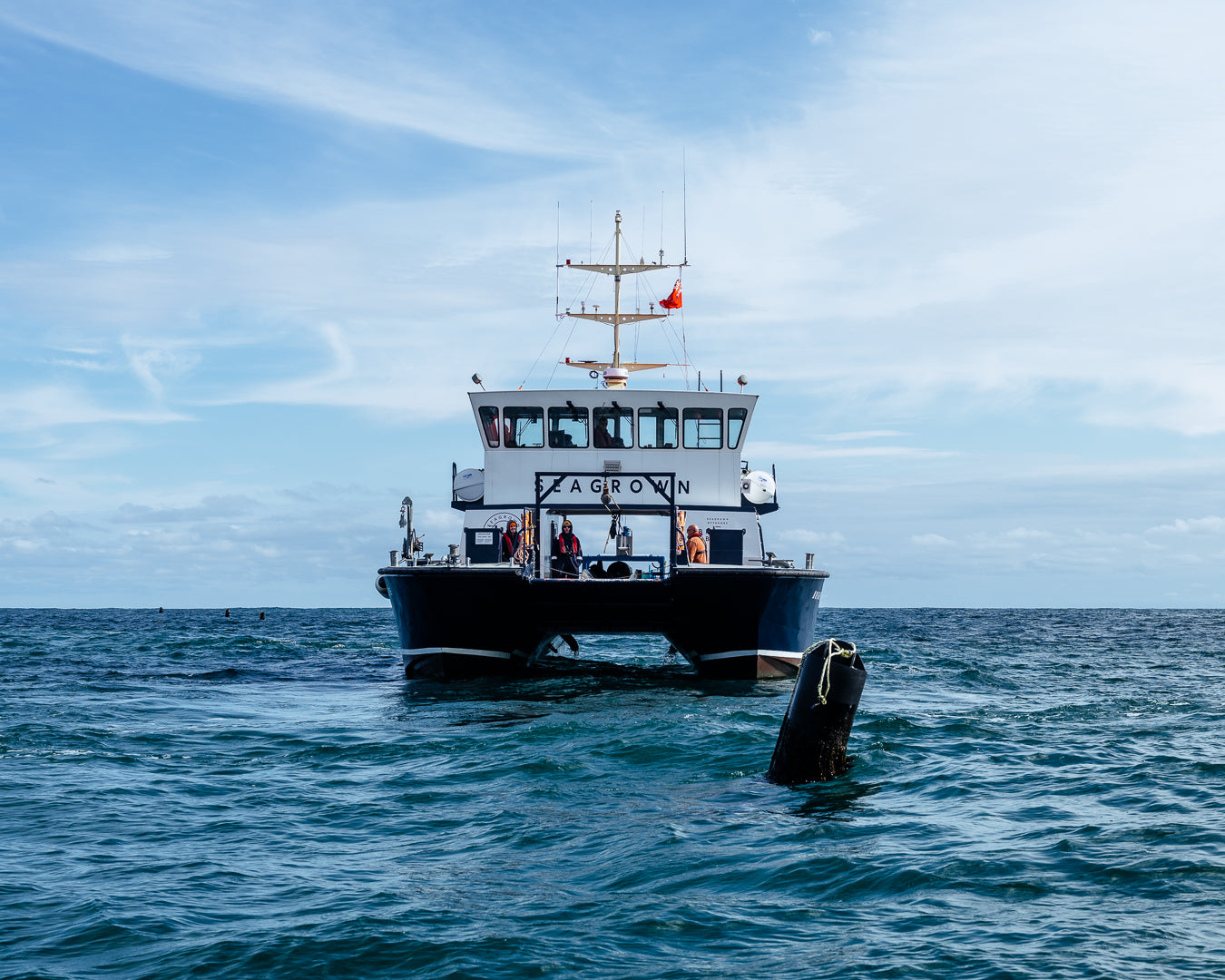
The system demonstrated survivability through everything the North Sea brings – including storms with waves over ten metres; it can be deployed in under twenty minutes with a footprint smaller than a car parking space and demobilised rapidly if the need arises. Shellpedo carries that same engineering into shellfish. Together, they allow a single system and one point of accountability for offshore seaweed and shellfish work, wherever the site.

This capability can go anywhere. Wherever there's a coastline, a licence and a case for growing marine life, this is a system — and a team — that already knows how.

Interested in what this could look like where you are? Get in touch.